
School management software with forty-three modules and one student record
Everything the software does, grouped by the department that uses it. Where a module has its own page, it explains what it does and — unusually for this category — what it does not.
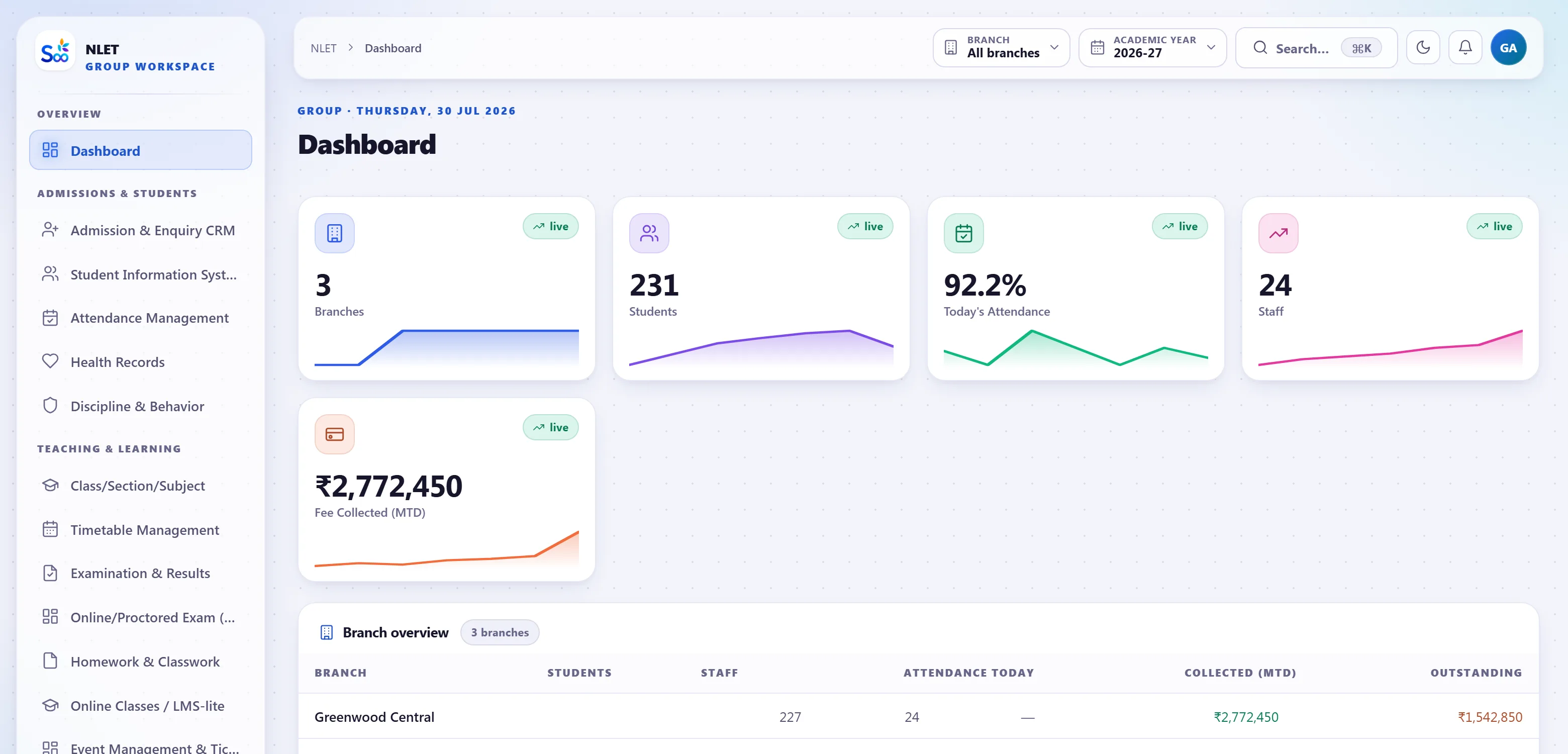
What the number means
Counted from the module registry in the software, not from a brochure.The record, and how a student gets onto it
Everything downstream depends on this being right, which is why admissions and the student record are one continuous thing rather than two systems with an import between them.
What happens in a classroom, recorded once
Attendance, marks and homework are entered by the teacher who was there, for their own sections only, and everything downstream — report cards, parent alerts, shortfall lists — is derived rather than re-entered.
Money, with a real ledger underneath
This is the group that most distinguishes the product. Fee collection is common; a double-entry general ledger with periods that close, which the collection posts into, is not.
The parts of a school that are logistics
Transport, hostel, front office and facilities — where a school is most exposed to regulation, and where the records an inspection asks for either exist or do not.
Staff, and who can see what
Seventeen roles, each granted specific module permissions, with scope applied in the query rather than by hiding a menu item. This group is what makes the rest safe to open up.
Reporting, and the things a group needs
Statements generated from entries rather than assembled from summaries, and the platform features that matter once there is more than one campus or more than one brand.
Forty-three is not a boast
A long module list is easy to produce and easy to inflate. Two things are worth knowing about how to read this one.
Each module is a permission boundary, not a menu item. The reason the number is precise is that every module in the list is something a role can be granted or denied, checked identically in the browser and in the mobile API. That is why the count is 43 rather than a round 50: it comes from the registry the permission system reads, so it cannot drift from what the software actually has.
They share one student record, which is the only claim that matters. Any vendor can list forty modules. The question to ask in a demo is what happens when you change something in one of them — promote a batch, remove a student from a bus route, reverse a concession — and whether the other thirty-nine notice. Here they do, because there is one row rather than forty copies, and that is the difference between an integrated system and a suite that was assembled.
Which modules you get depends on your plan, and the plan pages state the count. Nothing here is charged per user, and there is no screen that opens a “contact sales to unlock” dialogue — if a module is in your plan it is on, and if it is not, the plan page said so before you bought.
Questions about coverage
Something not answered here?
Do we get all 39 modules?
Can we turn modules off that we do not want?
Which modules have their own detailed page?
Is there anything you deliberately do not build?
How often do new modules appear?
Is the module count how you price?
Do all 39 work on mobile?
Can we see the full permission matrix?
Bring your requirement list and we will mark it up
Send whatever list you are evaluating against. We will mark each line as yes, partly, or no — in writing, before you buy.
- No card required
- Your data stays yours — export any time
- Setup help included