
University management software as the group layer over many institutions
Each constituent school, college or department as its own campus with its own staff, fee heads and books — and one consolidated view of enrolment, collection and results across all of them.
Read this section before anything else on the page
A university has two distinct software needs, and we are honest about serving only one of them well. The first is running each constituent institution — admissions, fees, attendance, results, payroll — and consolidating it for the trust. That is what this product does, and does properly, with genuine per-campus isolation and a real consolidated ledger. The second is the academic administration of a degree-awarding body: credit frameworks, CBCS transcripts, board-of-studies curriculum governance, thesis and research administration, and affiliation of external colleges. Those are not modelled, and a university buying on the assumption that they are will be disappointed.
- 01 Genuine per-campus isolation A campus administrator sees only their institution — enforced in the query, not by hiding a menu. Two constituent colleges cannot see each other’s students, staff, fees or results.
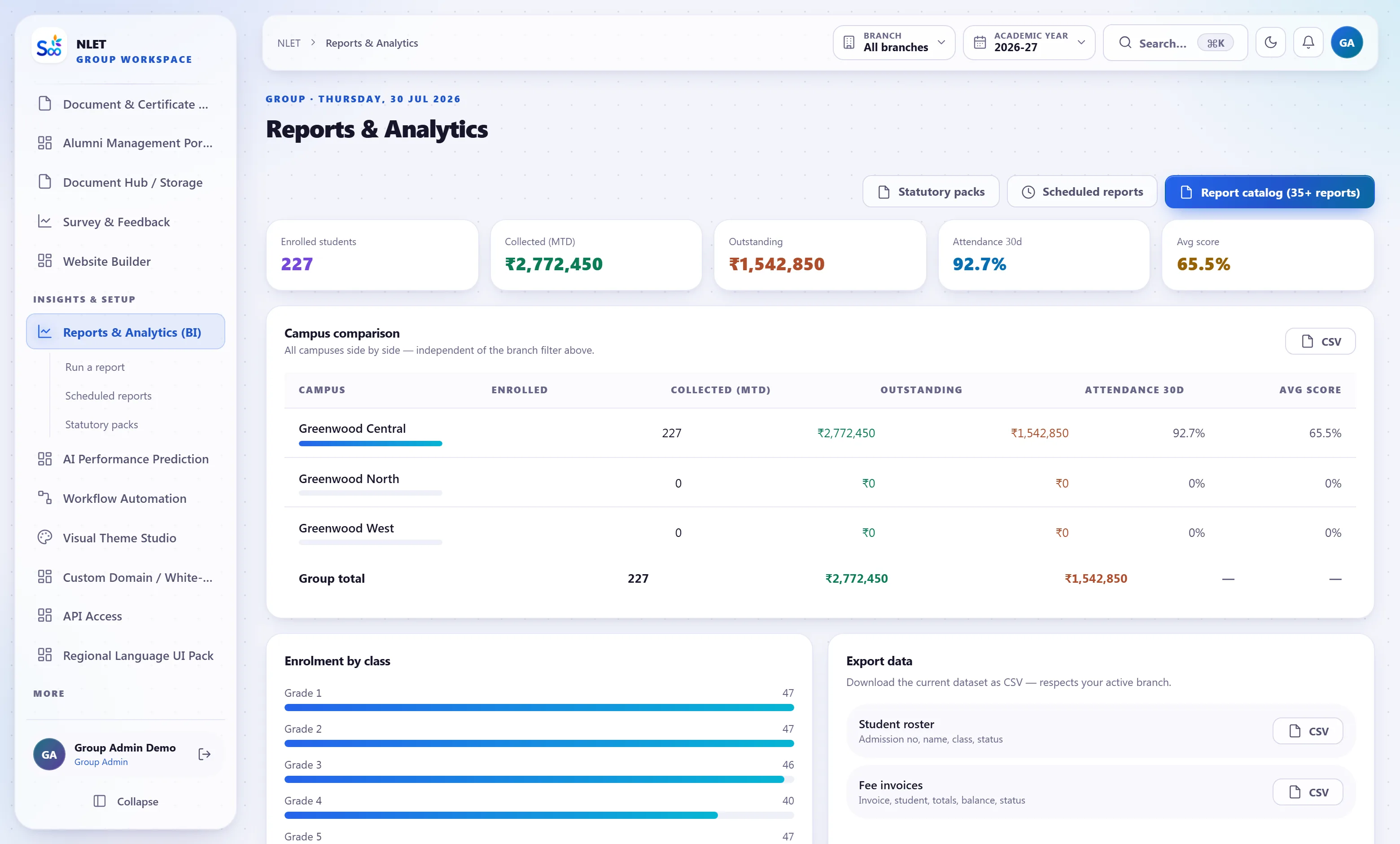
- 02 Consolidated without merging The group office sees enrolment, collection, outstanding, attendance and results across every institution side by side, while each institution keeps its own books that close independently.
- 03 Shared services where you want them One HR and payroll establishment across institutions if that is how the trust operates, or separate per institution. One vendor and procurement ledger, or several.
- 04 Not a degree-awarding academic system Credits, CBCS transcripts, curriculum governance, research administration and affiliation of external colleges are absent. Say so on the call and we will tell you what the practical arrangement looks like.
How the model maps to universities
The software was built around a school’s structure. Where your vocabulary differs, this is what it corresponds to — and where there is no correspondence, that is said too.
| In your institution | In School Techy | Notes |
|---|---|---|
| Constituent institution / faculty | Campus | Direct equivalent, with its own books and staff |
| Group / trust management office | Group workspace | Direct equivalent, read across all campuses |
| Department | Programme or stream within a campus | Direct equivalent |
| Programme & batch | Course & class | Direct equivalent |
| Semester with internal + external | Weighted exam terms | Direct equivalent |
| Credits, credit hours, CBCS | — | Not modelled |
| Degree transcript & convocation | Certificates, serialised and verifiable | Partial — not a credit transcript |
| Board of studies / curriculum approval | — | Not modelled |
| Research, PhD, thesis, viva | — | Not modelled |
| Affiliation of external colleges | — | Not modelled |
| Consolidated trust accounts | Per-campus books with group consolidation | Direct equivalent |
Where this is a good fit, and where it is not
The clearest way to judge this page: if the value you want is operational consolidation across institutions, it fits. If the value you want is degree-awarding academic administration, it does not.
What you actually get
The same product, with the vocabulary and defaults set for universities. Every module page below explains what it does and what it does not.
How the isolation actually works
This matters more for a group than for a single school, so it is worth being specific rather than saying “multi-tenant”. Every record in the system carries the institution it belongs to, and that filter is applied at the data-access layer rather than by each screen remembering to add a condition. A query written without a campus filter returns nothing rather than everything, which is the behaviour you want when the alternative is one forgotten clause exposing another college’s fee ledger.
On top of that, staff hold roles that are scoped to a campus. A branch administrator at one constituent college holds the administrator role for that campus only; the same person can hold a different role at a second campus if the trust genuinely wants that, and it is an explicit grant rather than a side effect. The group office holds a role that reads across campuses and, deliberately, cannot write into an institution’s books.
The same rules apply to the mobile API. There is no version of a request — browser or phone — that returns another institution’s data to a user who lacks the grant, because the narrowing happens in the query rather than in the interface. That is the difference between isolation and a hidden menu item.
Consolidation without losing the individual books
A trust needs both: each institution’s accounts must stand on their own for its own audit, and the trust needs a consolidated position. Doing this with a single set of books and a cost-centre column is where school-group accounting usually goes wrong, because a period cannot then be closed for one institution without closing it for all.
Here each campus has its own chart of accounts, journals and accounting periods. One college can close March while another is still posting. Consolidation reads the underlying journals rather than a summary, so the trust’s income and expenditure and balance sheet are derived from the same entries the institutions’ own statements are derived from — and cannot drift from them.
Inter-institution transactions — a shared bus, a teacher on secondment, a central purchase allocated across three campuses — are recorded as entries on both sides rather than as a note, which is what makes the consolidated position reconcile.
Questions from universities
Something not answered here?
Is this a full university ERP?
Can each constituent college keep separate accounts?
How is one college stopped from seeing another’s data?
Can a student move between our institutions?
Can we run one payroll across all institutions?
What does the group office actually see?
How many institutions can it handle?
Can we white-label it for each institution?
A twenty-minute fit assessment, with the gaps named
Tell us how many institutions, what each awards, and whether a credit transcript is mandated. You will get a straight answer, including the parts we do not do.
- No card required
- Your data stays yours — export any time
- Setup help included